What Is a Romance Scam and How Do You Protect Yourself?
Learn what a romance scam is, the warning signs to watch for, and what to do if you've already sent money or think someone is targeting you.
A romance scam happens when someone builds an online relationship with you to gain your trust and eventually ask for money. The relationship may feel real, but the person behind it is using that connection for financial gain.
These scams can develop over weeks, months, or years. The person may message every day, share personal stories, talk about a future together, and seem genuinely invested in your life before money ever comes up.
That time and attention are part of what makes romance scams so convincing.
A romance scam is a type of fraud in which someone creates or uses a false identity to form a relationship and gain another person’s trust. Eventually, that trust is used to ask for money or financial information.
The relationship is the setup. The request for money is the goal.
The person may claim to be working overseas, serving in the military, dealing with an emergency, or temporarily unable to access their own money. The details change, but the pattern is usually similar: there is always a reason you cannot meet and, over time, a reason they need financial help.
The scale is significant. According to the Federal Trade Commission, people lost over $2.1 billion to romance scams in 2025. Most of these scams started over social media.
If you have already sent money to someone you now think may be scamming you, stop sending anything else. A new request may be framed as the final payment needed to solve the problem or recover what you already sent. Do not pay it.
Contact the company you used to send the money as soon as possible.
If the payment involved your bank, card or another financial account, contact that provider too and explain what happened.
Report the scam to the Federal Trade Commission through ReportFraud (link: ReportFraud.ftc.gov ) and to the FBI's Internet Crime Complaint Center, or IC3 (link: IC3.gov).
You should also report fraud to MoneyGram if a MoneyGram transfer was involved.
Save messages, emails, usernames, profile information, phone numbers, receipts and payment records. Take screenshots before blocking or deleting accounts.
And be careful if someone now offers to recover your money for a fee. That can be another scam.
Romance scams don't only start on dating apps.
Someone may contact you through social media, a direct message, an online game, a hobby group, or another community where people naturally talk to strangers. Some begin with a text that appears to have been sent to the wrong number.
The conversation may not seem romantic at first.
A stranger might comment on something you posted, ask about a shared interest, or simply keep a conversation going after an accidental message. Over time, the contact becomes more personal.
An online dating scam may work the same way, but with an obvious romantic context from the beginning.
What feels like a chance encounter may be one of many approaches being made at the same time. The personal attention comes later, once someone responds.
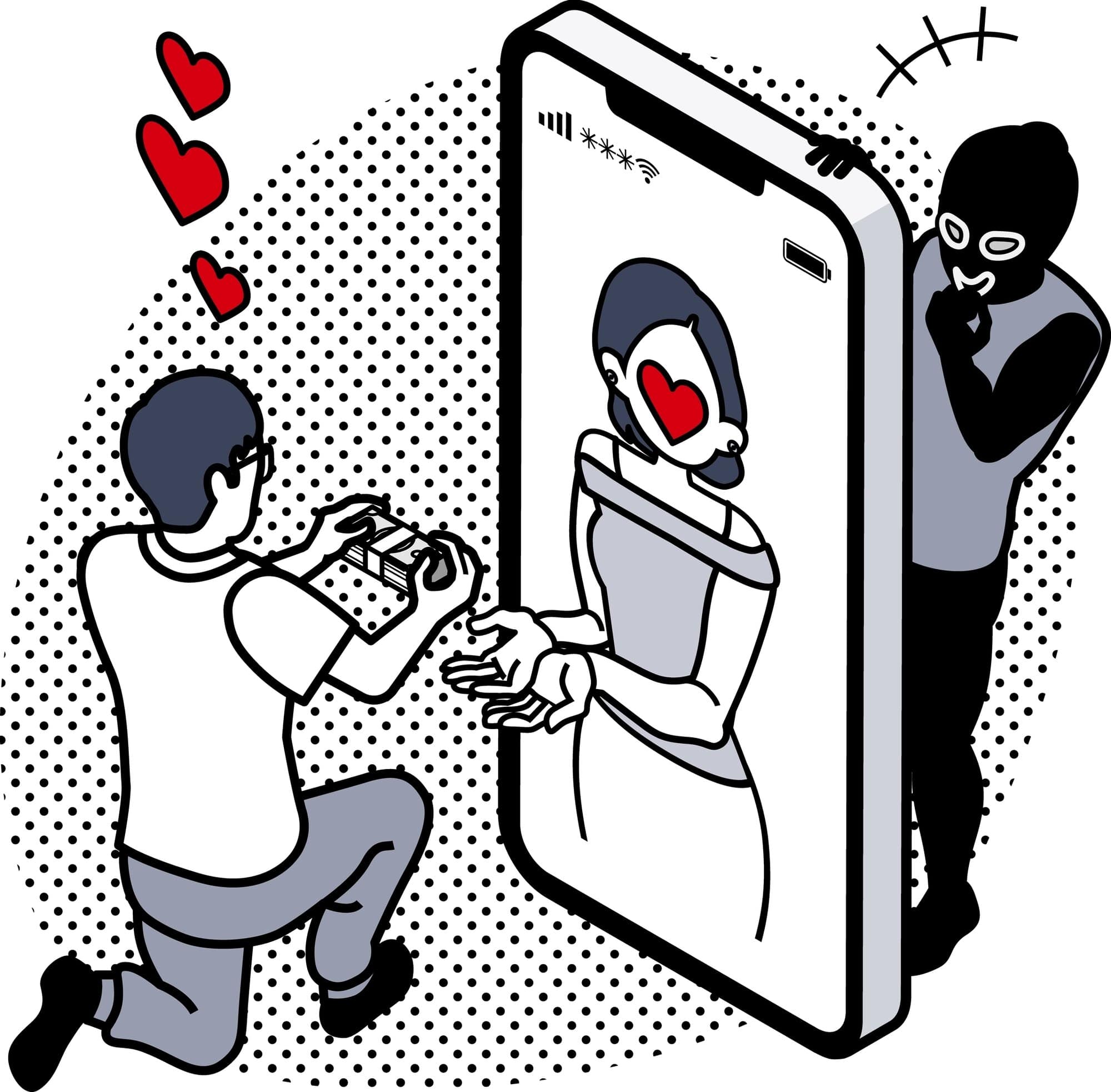
There isn't one exact script, but many romance scams follow a recognizable progression.
The conversation starts somewhere online.
The person may have a polished profile and a believable story about their job, family, and where they live. Their photos may look completely ordinary.
They show interest quickly and keep the conversation going.
Messages become frequent. The person may text every morning and every night, ask personal questions, and remember small details you've shared.
They may begin talking about love or a future together surprisingly early.
At some point, they often suggest moving away from the original platform and onto text, email, or a private messaging app.
There is usually a reason you can't meet.
They may say they're deployed with the military, working offshore, traveling for business, working as a doctor overseas, or dealing with circumstances that keep changing their plans.
A canceled visit on its own doesn't prove anything. A relationship that goes on for months while every attempt to meet is blocked by a new emergency is different.
The first request may be relatively small.
There might be a medical bill, travel problem, phone issue, customs charge, or another temporary expense. The person may seem embarrassed to ask and promise to repay you.
A smaller request can make the situation feel more reasonable.
If you send money, another problem may follow.
Once money has been sent, the circumstances can escalate.
A flight requires another fee. A package is stuck in customs. A bank account is frozen. A medical situation gets worse. An investment needs one more payment.
The details may change, but the solution is always: send more money.
This is also where it can become especially difficult to stop. If you've already sent a significant amount, another payment may feel like the only way to protect what you've already put in.
That pressure is part of the scam.
Romance scams use different stories, but some appear again and again.
This last version can overlap with what's commonly called a pig butchering scam, where a relationship is used to build trust before the person is directed toward a fraudulent investment.
The stories are different, but they solve the same two problems for the scammer: why you can't meet them and why they need your money.
Scammers commonly ask for payment methods that can move money quickly and may be difficult to recover once the payment is complete or the funds have been collected.
That can include money transfers, gift cards, and cryptocurrency.
A request for one of these payment methods should make you stop and verify who you're dealing with before sending anything.
It is also important to be clear about what payment services can and cannot do. No payment method can guarantee protection when a customer knowingly authorizes a payment but has been deceived about who is receiving it or why.
One sign alone may have an innocent explanation. Several together are a reason to stop and take a closer look.
These romance scam warning signs are worth taking seriously even when everything else about the relationship feels normal.
If something doesn't add up, you don't need to prove that someone is a scammer before slowing things down.
You can verify what they've told you first.
Save or screenshot a profile photo and use a reverse image search tool to see where else it appears online.
A photo connected to multiple names or unrelated profiles is a major warning sign.
A clean result isn't proof that someone is real, though. AI-generated photos and stolen images that haven't been widely indexed can make this check less conclusive than it once was.
Ask to have a normal, live conversation rather than relying on prerecorded videos.
If there is always a new reason a video call can't happen, pay attention to the pattern.
Technology has also made video and voice harder to use as proof on their own. Treat a call as one piece of verification, not the only one.
Notice whether basic details change.
Where do they live? Where did they grow up? What company do they work for? Why exactly can't they meet?
You don't need to interrogate anyone. You're looking for whether the story you've been told remains the same over time.
If a message sounds unusually formal or scripted, search a distinctive sentence from it online. Scam scripts are sometimes reused.
This may be one of the most useful checks.
Someone outside the relationship isn't experiencing the same emotional pressure and may notice contradictions or patterns that are harder to see from inside it.
Catfishing can involve someone lying about their identity for many reasons. Once that false identity is being used to obtain money, you're dealing with something more serious.
Telling someone, "You're being scammed," may seem like the fastest approach. It can also end the conversation.
The relationship may feel completely real to them. They may have spent months talking to this person and shared things they haven't told anyone else.
Start with questions instead.
Ask whether they've met in person. Ask what happens when they suggest a video call. Ask whether money has come up. If there's a specific story that worries you, offer to help verify it together.
Try not to make the conversation about whether they were foolish to believe someone. Make it about the facts that can be checked now.
If they aren't ready to hear it, staying available may be more useful than pushing until they stop talking to you.
Reporting helps create a record of what happened and can give investigators and platforms information that connects one report to others.
Reporting doesn't guarantee that money will be recovered or that the person behind the account will be identified. It can still provide useful information, especially when the same accounts, phone numbers, payment details, or identities appear in multiple reports.
For more information, see protecting yourself from fraud.
Where to get support
Losing money in a romance scam can be financially difficult, but the relationship itself can make the experience especially painful.
Someone may be processing the loss of money and the realization that a relationship they believed in wasn't what it seemed.
That can also make people reluctant to tell family, friends or authorities what happened.
You don't have to handle it privately. Consider talking to someone you trust and contacting the appropriate financial providers and reporting agencies.
And if someone you know tells you this has happened to them, listen before you judge. The person behind the scam may have spent months deliberately earning their trust.
It depends on how the money was sent, whether the payment or transfer has been completed or collected, and other circumstances.
Contact the payment or transfer provider immediately and explain what happened.
Be cautious of anyone who promises they can recover money for an upfront fee.
If you believe you've sent money as part of a scam, contact customer care and report fraud to MoneyGram as soon as possible.
Once money is transferred and received it cannot be recovered and, unfortunately, you will be at a loss for any money transferred.
You can report suspected fraud to law enforcement as well as the FTC and FBI IC3.
Whether a specific agency investigates an individual report depends on the circumstances. Reporting still creates a record and may help connect your experience with reports involving the same person, account, or payment details.
Sometimes an investigation can connect accounts, payment information, or other evidence to the people involved, but online identities can be false, stolen or operated from another country.
Don't keep communicating with someone simply to try to identify them yourself. Save the evidence you already have and provide it when you report the scam.
Once you believe you're dealing with a scam, you don't need to keep the relationship going to collect more evidence.
Save the messages and records you already have. Continuing the conversation may expose you to more pressure, requests for money, or attempts to obtain personal information.
Stop sending additional information and save a record of what you shared.
Because identity documents can contain information that may be misused, consider following current FTC guidance for identity theft and taking the recommended steps for the specific information that was exposed.
Not necessarily. One missed or refused call doesn't prove someone is running a romance scam.
But repeated excuses for never meeting or speaking live, especially when combined with requests for money, urgency or inconsistent stories, should be taken seriously.
A pig butchering scam is a long-term fraud in which someone builds trust before directing the person toward a fraudulent investment, often involving cryptocurrency.
Some begin with romantic attention, while others start as friendship or casual conversation. The relationship is used to make the investment recommendation feel trustworthy.
Sending money to someone whose identity you haven't independently verified carries significant risk, particularly when you've never met them in person.
See why you should never send money to someone you have not met for the broader MoneyGram position and steps you can take before sending.